
Show Me Your Bottom Line: Art and Eco-Punishment
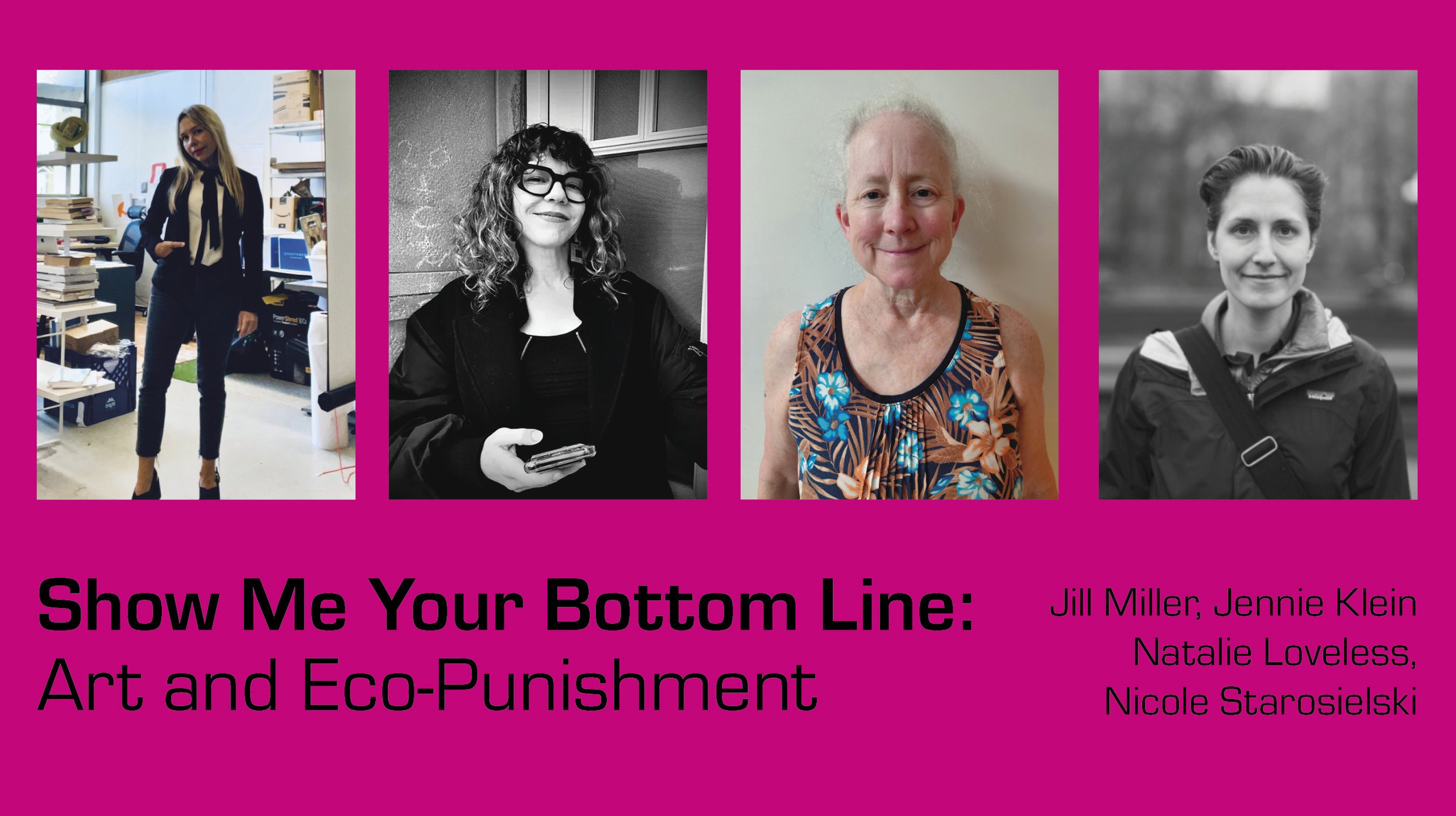
A panel discussion featuring Artist Jill Miller
with Art Historian Jennie Klein, Artist and Art Historian Natalie Loveless,
and Media Scholar Nicole Starosielski (moderator)
A discussion of eco-punishment and bottoming. Artists and art historians ask: can performance art be used as a corrective mechanism? Is there a place for queer sexualities, kink, and sado-masochistic drives in environmental retribution?
Register to Attend:
presented in conjunction with
HARD RESET
An Eco-Humiliation Ritual
Jill Miller
June 27th to August 22nd, 2026
Hard Reset is a performance project, sculpture, and video installation by artist Jill Miller, which employs the ritualized punishments of sado-masochism as instruments of retributive justice in the face of environmental destruction, playfully asking: Is it possible to make the people who profit from digital technologies accountable for the ecological devastation they cause through the erotic disciplining of the body?
ABOUT THE PARTICIPANTS
Jill Miller is an interdisciplinary artist whose practice interrogates the intersections of human bodies, technological systems, and structures of power. Her projects engage the materials and conditions of contemporary life, ranging from labor and carework to networked intimacy and electronic waste. Through performance, video installation, and participatory encounters, Miller transforms these systems into experiences that are often uncomfortable, humorous, and emotionally charged. Her work prompts viewers to confront the ways our relationships to technology are never neutral, but deeply entangled with larger social and ecological consequences.
Jennie Klein is a Professor of Art History at Ohio University, specializing in contemporary art and performance. Klein is co-author with Beth Stephens and Annie Sprinkle of Assuming the Ecosexual Position (2021) and co-editor with Natalie Loveless of Responding to Site: The Performance Work of Marilyn Arsem (2020), co-editor with Deirdre Heddon of Histories and Practices of Live Art (2012), and editor of Letters From Linda M. Montano (2005). More recently, Klein has authored four essays for the catalog Reliving Time, produced by the cohort Time for Live Art (2024).
Nathalie Loveless is a professor of Contemporary Art and Theory in the History of Art, Design, and Visual Culture division of the Department of Art & Design at the University of Alberta, located in ᐊᒥᐢᑿᒌᐚᐢᑲᐦᐃᑲᐣ (Amiskwacîwâskahikan) on Treaty Six territory, where she also directs the Research-Creation and Social Justice CoLABoratory. Her publications include How to Make Art at the End of the World: A Manifesto for Research-Creation (Duke UP 2019), Knowings and Knots: Methodologies and Ecologies in Research-Creation (University of Alberta Press 2019), Responding to Site: The Performance Work of Marilyn Arsem (Intellect Press 2020), and the Routledge Companion to Performance Art (2022). In 2020 was elected to the Royal Society of Canada (College of New Scholars, Artists, and Scientists) for her scholarship at the intersection of research-creation and social and ecological justice.
Nicole Starosielski conducts research on global internet and media distribution, communications infrastructures ranging from data centers to undersea cables, and media’s environmental and elemental dimensions. Starosielski is author or co-editor of over thirty articles and five books on media, infrastructure, and environments, including: The Undersea Network(link is external) (2015), Media Hot and Cold(link is external) (2021), Signal Traffic: Critical Studies of Media Infrastructure(link is external) (2015), Sustainable Media: Critical Approaches to Media and Environment(link is external) (2016), Assembly Codes: The Logistics of Media(link is external) (2021), as well as co-editor of the “Elements(link is external)” book series at Duke University Press.